Showing posts with label optimal health. Show all posts

Monday, July 9, 2012

Total Renewal Approach from Personal Trainer Los Angeles

Monika Tarkowska-Carter, personal trainer in Los Angeles, CA, owner of Fitness Science, Inc describes her philosophy.
There is more to health than the absence of disease!
Some components of health:
*Energy: do you have enough energy?
*Exercise
*Healthy eating: Are you eating healthy but not eating for weight loss? Is your diet right for you?
*Optimal weight
*Sleep
*Detoxification: Are you struggling to lose weight because of toxins in your body?
*Stress: Stress affects your ability to lose weight.
People are not the same. One of the biggest sins of the nutrition industry today is that we treat everyone as if they were the same.  Monika looks at a person's biochemical individuality through extensive questionnaires to develop the right approach for them.
This holistic approach to fitness, nutrition, and weight loss will look at all aspects of your life and health for total renewal.

Monday, December 19, 2011

Los Angeles Personal Trainer Lists 33 Cures To Your Health Woes Found in the Kitchen -

If you are thinking about making a resolution to seek better health in 2012, and you are thinking of hiring a personal trainer to help direct you, be sure that the personal trainer you select is qualified to help you with all aspects of fitness, including the nutritional component.  Below are some guidelines that will help you make certain that your diet is helping, not hurting, your healthy living goals.

THE CURE IS IN THE KITCHEN
“LET NOTHING WHICH CAN BE TREATED BY DIET BE TREATED BY ANY OTHER MEANS”
                                                                   (Maimonides)

By Monika Tarkowska-Carter CPT, LWMC, HLC                                                          


We often forget that clean water and healthy food are not only the foundation of health but have more power than medicines to keep us healthy. But the quality of what we put into our bodies is also of prime importance. If you build a healthy foundation with simple things like nutrition and exercise, your body will thrive.


 1. The most important yet cheapest thing you can do for your body every day is drink good quality pure water, ideally with a ph of at least 7.0.
For the rest of the list of Healthy Nutritional Tips, go to this blog post.


Monday, November 7, 2011

WEIGHT LOSS - SMOOTH SAILING OR AN OBSTACLE COURSE - PART 2

Physical Reasons
(Continued from May 3rd, 2011 post)
EVERYTHING YOU EVER WANTED TO KNOW ABOUT WHY YOU ARE NOT LOSING WEIGHT AND WHAT YOU CAN DO ABOUT IT.

By Monika Tarkowska-Carter, CPT, LWMC, HLC 2
I have promised a while back to spend some time explaining how to get around the weight loss hurdles, and how to address specific reasons why you might not be losing weight. Some of you have been asking for more specific pointers and ideas for quite some time so I will devote the next few posts to this very subject. In this post I am going to start with the explanation of the most basic reasons for failure which, so often, is the source of frustrations for many.

PHYSICAL
1. You exercise too little

This is a very obvious one, yet so many people still can’t grasp the fact that it is NOT enough to follow the minimum daily guidelines for exercise, which is 30 minutes a day of moderate intensity activity, 5 days a week. Yes, if you have been sedentary for years and are totally out of shape, it’s a good start, but this amount is not enough, by itself, to start losing serious amounts of weight. I am going to be very cautious here and refrain from giving specific amount of exercise time recommendations, since all of you are different, eat a different diet, have different metabolism, daily activity level and lifestyle, as well as different conditions that might preclude you from intense or prolonged exercise. Your diet is still at least 80% of your weight loss success, but this does not mean exercise is not important. It is, and very much so. Keep in mind, however, that in order to lose 1 pound of body fat you will need to have a deficit of 3500 calories. An average person weighing 150 lbs burns about 150-200 or so calories during a 30-minute brisk walk (and I mean brisk! – at the speed of about 4 mph). Let’s call it a power walk to distinguish it from a leisurely stroll. If you walk 5 days a week, you will burn +/- 750-1000 calories. That’s not even 1/3 of a pound. The rest has to come from somewhere else. You will still have to cut back an additional 2500-2750. I will talk about the nutritional factors in the following posts devoted specifically to that subject, but in general, cutting your calories too low is not good either, because you will constantly be fatigued and grumpy.  Depending on your initial weight, the best solution is to cut between 250-500 calories from your diet daily (this number will depend on your overall calorie allowance for the day), and make up the rest of the difference in slightly longer, or more intense, workouts. Your weight training sessions should generally not be longer than 1 hour (plus a short warm-up and stretch), and your cardio sessions between 20 and 60 minutes; 20 for those who are total beginners, or those advanced ones who can really push at high intensity; and 60 for those who need to burn some serious calories but are not yet capable of working out doing high intensity interval training. I am generally not a big proponent of endless cardio sessions, (unless you’re an endurance athlete, of course) as they are catabolic in nature, make you lose muscle and, as a result, slow down the weight loss. They also very often lead to overtraining. My advice would be to limit your cardio to no more than 40-45 minutes, but put forward your best effort and really kick up the intensity. Also, do more lean- muscle-building weight training that will shape your body better than any cardio.
2. You exercise too much

This is as bad as doing too little and still quite common. I am not contradicting what I just said in the previous point, but more is NOT always better. Burning fat is very energy consuming for your body and you simply cannot fatigue it to the point where it has none left. Your body will outsmart you any time and will stop losing weight to protect itself from more abuse. You will also most likely find yourself looking puffy and retaining water, since it can’t keep up with clearing all the metabolic waste products out of the system. Use your common sense, listen to your body and let it rest if you feel exhausted. You will have more energy for your next workout and you can make it harder.
3. Your exercise is inappropriate for your age, fitness level and goals


I encourage all of you to invest in a few sessions with a good personal trainer. He/she will be well worth your time and money. Nothing can be more frustrating than wasting your time at the gym and not seeing results. Stop doing things you are not sure of or have no idea about. Your exercise program has to have arms and legs, be appropriate for you at the level you are currently at, be consistent with your goals and be performed according to a well designed plan that will progress you in the right way. Otherwise, not only will you not see much in terms of results, but you will be going in circles, and will eventually give up.
4. Your exercise intensity is too low or too high


Results oriented exercise is actually a science. Many people forget about it completely and think that anything will do. If you’re serious about results, ask someone who is trained in this area to figure out what intensity you should be working out at. This applies as much to cardio as strength training. If the intensity is too low, you are not going to challenge your heart or your muscles enough to get much benefit; if it’s too high, the chances are you will overtrain very fast, and might get injured in the process, which will only delay any possible progress.

5. Your exercise program lacks the proper balance of cardiovascular exercise and strength training

With all the knowledge out there on the importance of both, some people still often choose one over the other. From my observations, it’s usually the cardio lovers that tend to shun strength training and not so much the other way around. Keep in mind that both types of training affect the amount of calories burnt, and have the ability to increase your metabolic rate for quite a few hours afterwards. How much, depends on the intensity of the training itself. Cardiovascular workouts can burn quite a few calories during the session, while weight training builds muscle, and this in turn increases the metabolism overall, since muscle is a more metabolically active tissue than fat. The elevations in metabolism don’t seem very impressive in numbers, but add up considerably over time, so don’t ignore them. As a general rule, however, the more intense the workouts, both cardiovascular and strength training, the more additional calories your body will burn afterwards.
6. You are overdoing cardio

If you want to have a low percentage of body fat and look really lean, stop overdoing cardio. Your body gets very efficient at doing something you subject it to for such long stretches of time and will burn fewer and fewer calories the more you beat it up. Just look at so many “skinny fat” aerobics instructors who, though not heavy in a true sense, have a pretty high body fat. The same goes for long distance runners. Though lean due to pure amount of training, they look like famished skeletons with no muscle at all. Long aerobic workouts almost always guarantee that you will be burning precious muscle tissue, which is the last thing you want if you’re trying to lose weight. Also, it is almost a given that if you can do something for very long, you are not working out intensely enough.
7. Your exercise program is poorly designed or lacks any specific design to begin with


So you have read a few magazines and try to follow a routine described in the latest Men’s Health or Shape. Though some, or even all, exercises may be good, they may not always be the best for YOU. They don’t take all your particular circumstances into consideration and are almost never designed as part of a smart program, based on YOUR needs and goals. Or maybe you have designed your own routine, based on what you have observed in the gym – an even worse approach. Just because someone has a body you would like to have, does not mean you should follow everything they do. Their genetics are different, they may not have muscular conditions or imbalances that maybe you have, and you don’t know what else they do, or what they eat, to achieve the body you’re admiring. Exercise program design is a science and an art. Don’t just guess, or you’ll get nowhere.
8. Your form is incorrect on pretty much everything because you never learned how to perform the exercises appropriately. You think it’s OK because you’ve watched others do it

There is no substitution for working with a qualified trainer, at least for a few sessions. It is very hard to get the right feedback on whether you are actually performing the exercises correctly, especially if you have never done them before. It may seem to you that you are doing things exactly as they should be done, but only a qualified professional can spot where you’re lacking in form.  Invest in a few sessions and learn proper form. Otherwise, you are not going to achieve the results you are looking for.
9. You have no idea about proper intensity, load, sets, reps, tempo, rest periods between sets, etc. and how they affect your workout outcome

As I said in point 7, program design is a science. It takes years to study the human body and how it responds to various ways of training. Do you really know what intensity in a weight training session is? It is a degree of one’s applied strength relative to their current level of maximum strength. Probably not what you thought it was. How about load, tempo or rest periods? Do you know that when you change the rest periods just slightly, your whole program has just changed and you might be getting completely different results than you actually intended? If you plan on working out on your own and not wasting your time, make sure you learn about all the factors that affect your workout BEFORE you hit the weights.
10. You simply don’t have the knowledge when it comes to exercise and workouts


This is a very common problem, yet I see people in gyms all the time that insist on using weights and machines having absolutely no clue how to do so correctly. Please, please spend a few bucks and learn first. It will not only prevent an injury but is the ONLY way for you to get some benefits out of your workout.

11. You lift weights that are way too light to make any significant difference in gaining lean body mass and losing fat
This applies mostly to women, but not entirely so. In order to achieve strength gains, increase muscle size or just shape and tone your muscles, you need to challenge them enough so that they could respond by adapting to the new level of effort and thus changing the way you would like them to. This can only be done with a proper overload. If the weights you’re lifting don’t provide much of a challenge, you are wasting your time. For those women who are afraid of bulking up, I have a few words of assurance: we don’t have enough testosterone to build giant muscles that easily and you would have to lift very heavy weights in order to do so. If, however, you have a sizeable fat layer on your muscles, and you gain even a little bit of lean body mass, without losing any fat, it may look like you’re getting big. Extra muscle is a good thing, but you also have to look at your diet, incorporate cardiovascular exercise and stretch, in order to lose the fat and look really lean.
12. You don’t get enough recovery

One of the biggest mistakes people make when they get too eager to lose weight fast is forgetting that their bodies are not ever-ready batteries. Your muscles, and your cardiovascular system, need a sufficient amount of time to recover. Your muscles grow and change during that time, NOT when you put them through hundreds of contractions under heavy resistance. Remember to allow yourself enough rest days. It’s different for everyone. Some people can work out 5-6 days straight, and then take a day off; others might do 2 very intense sessions and have to rest on the 3rd day. All depends on your fitness level and your body’s ability to recover. There is no golden rule here.

Stay tuned for Part 3 – the Nutritional Reasons for not losing weight – coming soon.


Thursday, August 4, 2011

CAN YOU JUST TELL ME WHAT TO EAT?

FROM THE SERIES “ASK THE TRAINER”

By Monika Tarkowska-Carter, CPT, LWMC, HLC 2

Well, not exactly. And yes, it is possible, but I like to teach my clients about their bodies and encourage them to experiment with themselves and observe how they are feeling on a daily basis. If I were to just give clients a menu to stick to, it might be OK for a short period of time but it will make them slaves to a particular plan. I like to know that my clients are educated enough about food that they can make good healthy choices no matter where they are and what situation they find themselves in. Giving menus can be very helpful when trying to bring someone’s weight down quickly in a very serious way – let’s say for a bodybuilding competition, but those guys usually already know what they are doing (which is not to say it’s always healthy!). It also sometimes helps for a short period of time, when a client needs to understand what a certain amount of food will look and feel like, or more specifically – what appropriate portion sizes are and how can they actually be sufficient. But in general, I am very against telling people what to eat, because it takes the power of their own choice and responsibility away from them and that usually backfires long-term, when there is nobody to hold their hand and be accountable to. Your health is your own responsibility and I like to teach my clients this simple truth from the very beginning of our relationship.

Tuesday, July 26, 2011

ARE CARBOHYDRATES REALLY BAD?

FROM THE SERIES “ASK THE TRAINER”

By Monika Tarkowska-Carter, CPT, LWMC, HLC 2

My answer is: it depends, AND depends for whom, as well as what kinds of carbs.

First and foremost let’s clarify what a carbohydrate is, because for some people it is still not so clear. We all know that pasta is a carbohydrate. So are rice and potatoes. So is bread. But where do fruits, vegetables, legumes, dairy and various drinks fall in? Well, they are all carbohydrates, in a sense.  We can divide them into almost pure carbohydrates, like grains, and, what I call, mixed carbohydrates like dairy. The reason why I call them mixed is that, in most cases, they are a source of both carbohydrates and protein, and sometimes also fat. We can also divide them into complex carbohydrates which are called starches and simple carbohydrates like fruits. All carbohydrates get broken down in our digestive system into simple sugars, but it is the speed of breakdown as well as the insulin response they generate that differentiates them.

Vegetables are definitely a great carb and most people should be eating more than they currently are.


They are full of vitamins, minerals, protective antioxidants and fiber. The only time you may want to rethink your veggies is if you are either allergic to anything or if it’s hard on your digestive system. Some may argue that since humans are not ruminants, we process raw vegetables, especially those like lettuce, chard, spinach, etc. differently, and are not really well equipped, so to speak, to digest them. My own advice is: see how they make you, and especially your digestive system, feel.  Are you bloated? Do you have a lot of gas and discomfort after eating them? Listen to your body. You may be one of those for whom lightly cooked vegetables are better.

Fruit – generally on my good list, as long as it’s ripe, ideally in season and organic, you are not allergic to it OR, and this is important, you are not insulin resistant or diabetic.


Unfortunately, many people walk around overweight and with insulin resistance, not knowing about it. If you are overweight and have trouble losing weight no matter what you do, insulin resistance may be one of the culprits. If you do indeed have it, it means that your body cannot handle sugar very well and watching your sugar intake in any form, including fruit, is necessary. Also, if you are trying to lose weight or drop body fat, you will need to limit your fruit intake, for the same reason, to 2-3 servings of fruit per day. Remember, that 1 serving is a medium piece of fruit or ½ cup of cut up fruit.

Legumes are a great source of carbohydrates and protein, as well as antioxidants and fiber.


Because of that, not much is needed to make one feel full. That’s one of their great benefits. But….protein makes only a small % of total calories. Most of them (about 70% depending on the type of bean) come from carbohydrates. So, if you’re carbohydrate sensitive or are watching your diet, you should be mindful of the portions or, in some cases, skip them altogether.

Grains – that’s a whole subject depending on which camp you are in: carb camp or no/low carb camp.


There are valid arguments for both. Most people are OK eating small amounts of grains (unless you have a clear allergy or sensitivity to gluten, of course). It’s when the portions become big, or huge, that we get into trouble. A lot of people don’t even know what a small portion would be, and that’s a real problem. Another issue is the form in which grains come in: are they whole grains as they would appear in nature, or completely processed, denatured and with all their nutrients sucked out of them? Even if they are fortified, it’s all synthetic vitamins and minerals, and natural are always better for the body. Remember that no matter how healthy, bread, pasta, white rice, pancakes, pretzels, tortillas, etc., are all processed products and they will enter your blood stream much faster than whole grains they came from, often times causing fluctuations in blood sugar, which, in turn, result in insulin spikes and resultant fat storage in your adipose tissue.
Unfortunately, gluten intolerance and gluten, and especially wheat, sensitivity is becoming more and more widespread. One of the reasons could just be the fact that more attention is being paid to this phenomenon; another that we are eating more grains than ever, and a different one yet, that we are buying genetically modified foods, which alter our digestive system. GMOs are being downplayed by the food industry as safe but the results speak for themselves.  If you are one of those people who struggle after eating grains or you have insulin resistance or diabetes, or you are simply a protein metabolic type, then you should certainly stay away from them, and make sure you get the nutrients you will now be missing from other sources.

Diary – another food that clients often have trouble classifying: protein, fat or carbohydrate?


Well, actually it is all three. High fat cheeses have almost no carbohydrates, but very high fat and a decent amount of protein. Yogurt, can be full fat, low fat or nonfat but is usually mostly carbohydrates (about 2/3) with a much smaller percentage of protein (about 1/3 in a nonfat variety). The exception is Greek yogurt which is very high in protein and has a much smaller percentage of carbohydrates. And fruit sweetened and flavored yogurts are another chapter altogether. Many of them contain up to 7 tsp of sugar, some natural from lactose and the rest from various sweeteners.

And finally drinks. What are they?


I have heard from some clients that they are just that – drinks. The answer is: most of them, with the exception of alcohol, are carbohydrates. Milk and drinking chocolate (and a few others) would be an exception here, being protein, fat and carbohydrates in one. Soda drinks and energy drinks are pure carbs. Energy drinks are needed only in low concentrations to replenish electrolytes when your workout exceeds 90 minutes or you’re sweating profusely in hot weather. Most of the time they are needed only by competitive or endurance athletes. These “monsters”, or sugar “bombs” as they should be called, are pure sugar. They are, so called, empty calories – they put calories in, but without any nutritional value. Worse, they actually deplete you of important nutrients in the digestion process. Many sports drinks or large energy drinks available these days on the market can have up to 100 g of sugar, which translates to 25 teaspoons. One of the best ways to replenish your electrolytes, during and after your workout, (if you’re an average person and not a competitive or endurance athlete), is diluting a teaspoon of organic raw honey and 1/8 tsp of good quality sea salt (like Celtic Sea salt) in a quart of water.* Juices, though full of vitamins, (mostly if freshly squeezed and not pasteurized) are deprived of fiber and are basically the source of liquid sugar. Once in a while, it’s OK to have a small portion of freshly squeezed juice. Otherwise, limit their intake and choose fresh fruit instead.

Alcohol is in a class of its own.

Its calorie value is similar to that of fat. It provides 7 calories per gram. The problem with alcohol is that it gets broken down to fatty acids and needs to be detoxified by the liver first, before the body can go on with the fat burning process. It is for that reason, that alcohol should be one of the first foods to eliminate if weight loss is desired.


So, to sum it all up: choose your carbs carefully, try to eat mostly whole carbs, learn what the right portion sizes are and be extra careful with the high glycemic ones if you are struggling with extra weight or have insulin resistance. Be CARB SMART!
THIS?
                                                            Or THIS?


*In research done on comparison of sports drinks to water with a small amount of honey, the latter outperformed every sports drink on the market.


Wednesday, July 20, 2011

WHY SHOULD I EAT OFTEN IF I AM NOT HUNGRY?


FROM THE SERIES “ASK THE TRAINER”

By Monika Tarkowska-Carter, CPT, LWMC, HLC 2
This is a very important question, especially if you’re trying to lose weight. The less often you eat, the slower your metabolism becomes. Breaking down foods, digesting them, absorbing and assimilating nutrients takes energy. Every time you eat, your body has to do the work, and this work burns calories. It is called: the Thermic Effect of Food. It usually amounts to about 10% of daily calories taken in. It may not seem like a big number but over weeks and months, if decreased to a bare minimum, it can contribute to weight gain considerably.

Another issue that is also very important here: if you don’t give your body food for 4 hours or more, it will automatically start going into starvation mode. What does that mean? This is actually what nature programmed us for. Thousands of years ago, during the times when our ancestors were hunter-gatherers, food was not always available. When it was, we ate more and the body stored fat for the times of famine. When it wasn’t, the body slowed down the metabolism to conserve energy. Unfortunately, our genes haven’t changed that much and this inherited ability remained. So…..every time you have a longer break in eating than 4 or so hours, your metabolism will slow down and stunt your weight loss efforts.

And here’s an important point: many people already have, what I call, a damaged metabolism. This means they have not listened to their body, either trying to lose weight in some drastic ways, or simply ignoring the body’s needs for good and frequent fueling. How many times have I heard from clients that they don’t eat breakfast because they are not hungry?


How many times do they just have a light salad for lunch?


And what happens then? Well, most of these people end up eating double the normal amount in the afternoon and evening, because the body is smarter and will always try to get what it needs.


Worse yet, they usually end up craving foods that are high in carbohydrates (especially sugar) and fat, because the adrenals are so stressed from trying to keep the blood sugar up throughout the day that they are literally screaming for it. And yes, you can “teach“ your body to not feel hungry, but it is NOT a natural feeling, especially if it lasts most of the day and then abruptly ends in the early evening. Not only will you almost always eat more, and of calorie laden bad foods, than you would have otherwise, but your body, trained now to know that you put it through times of famine during the day, will store most of these calories as your beloved fat in anticipation of more famine to come.

My clients are always surprised when I tell them that if you take 2 people and feed them the same amount of calories, but one will be eating healthy foods spread evenly throughout the day, and the other will be skipping breakfast, having very little for lunch and eating most of their calories from crappy foods, in the late afternoon, for dinner and late at night, the first one might even lose weight while the second one will most likely gain. There are some people who can eat one or two large meals a day and stay slim their entire lives, but these are few and far between. Most of us are not so lucky, so don’t look at other people’s habits.


So your best bet for successful weight loss is eating every 3, and at most every 4 hours, but in the form of smaller meals and snacks. And you won’t have to wait very long to see that all of a sudden you ARE actually hungry. It’s not a cause for panic, just a sign that your body is starting to work as it should and actually communicating with you about its needs. One additional benefit of eating this way, and therefore maintaining even blood sugar levels throughout the day, is that you will not be overworking your adrenals which have to produce high amounts of the stress hormone cortisol in response to low blood sugar. Cortisol, though a necessary hormone in our body, is extremely dangerous in high amounts. It can lead to all sorts of problems, including stunting the ability to lose weight.

Thursday, July 14, 2011

POST-WORKOUT PROTEIN SHAKE RECIPES

THE POST-WORKOUT MEAL DILEMMA - Part II


By Monika Tarkowska-Carter, CPT, LWMC, HLC 2


Get the best quality, organic fruit that’s in season. Squeeze the fruit juice as close to drinking as possible to allow it to retain all the vitamins which are highly perishable when exposed to oxygen. Always make sure the milks you’re using are organic. Raw animal milk is a much healthier option than pasteurized and homogenized, if you can get it. If you don’t eat dairy, try to find unsweetened nut or grain milks. If you can’t find them, the sweetened versions usually use evaporated cane juice or brown rice syrup. This is one time when it would be OK (though not great!) to use them, since the goal is to deliver fast acting carbohydrates to your muscles. Just remember to adjust all other carb amounts accordingly (for example – less fruit). Add some good fat in small amounts to help with protein digestion and absorption (remember: complete protein in nature does not exist without some natural fat in it!)

If you have specific “Why” and “How” questions, please refer to my previous blog article: “The Post-Workout Meal Dilemma”.

RECIPES

THE CARBOHYDRATE TO PROTEIN RATIOS ARE GIVEN FOR 25 G OF PROTEIN, UNLESS STATED OTHERWISE. IF YOU ARE USING  20 G, IT WILL INCREASE THE RATIO SLIGHTLY.
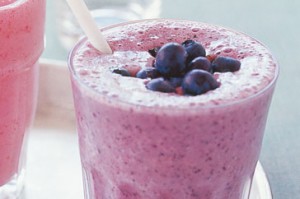
WILD BLUEBERRY-ORANGE 


Approx. 320-350 kcal; CHO:PRO 2:1 (CHO – 200 kcal, PRO – 80-100 kcal, FAT – 40-50 kcal)

1 cup (8 oz.) organic freshly squeezed orange juice
1 cup frozen wild blueberries*

4 Tbsp protein powder of choice (20-25g)

2 Tbsp organic coconut milk (or 1 tsp organic virgin coconut oil)
Blend in a blender at high speed.

Keep refrigerated if not using right away.

*You can also use fresh blueberries but frozen fruit gives more of a creamy texture.

 STRAWBERRY-ORANGE

Approx. 275-310 kcal; CHO:PRO 1.5:1 (CHO – 150 kcal, PRO – 80-100 kcal, FAT – 45-60 kcal)

3/4 cup (6 oz.) organic freshly squeezed orange juice
1.5 cups organic fresh or frozen strawberries

4 Tbsp (1/4 cup) protein powder of choice (20-25g)
1 tsp coconut oil/ OR 1/5 avocado

Blend in a blender as above

PEACH-BLUBERRY-ORANGE


Approx. 340-360 kcal; CHO:PRO 2.2:1 (CHO – 220 kcal, PRO – 80-100 kcal, FAT – 40 kcal)

1 cup (8 oz.) fresh orange juice
1 ripe peach or nectarine

½ cup frozen wild or fresh blueberries
4 Tbsp protein powder of choice (20-25 g)

1 tsp organic flaxseed oil
Blend in a blender as above


BANANA-BLUEBERRY


Approx. 290-310 kcal; CHO:PRO 1.7:1 (CHO – 170 kcal, PRO – 80-100 kcal, FAT – 36 kcal)
1 Cup unsweetened organic almond milk (like 365, available at Wholefoods) – it will provide 4 g of fat

1 1/3 cup blueberries
½ large ripe banana

4 Tbsp protein powder of choice (about 20-25 g)
Blend in a blender as above


VERY BERRY


Approx. 340 kcal; CHO:PRO 1.5:1 (CHO – 168 kcal, PRO – 112 kcal, FAT – 60 kcal) – calorie values when using nonfat milk

1 cup organic raw milk, kefir or cultured yogurt – low fat or nonfat – this will give you protein and carbohydrates
2 cups mixed berries (frozen or fresh)

3 Tbsp protein powder of choice (about 20 g)
2 tsp raw organic almond butter (if using nonfat milk)

Few drops of liquid Stevia as a sweetener
Blend in a blender as above


BANANA-CHOCOLATE-ALMOND


Approx. 270-290 kcal; CHO:PRO 1.5:1 (CHO – 150 kcal, PRO – 80-100 kcal, FAT – 36 kcal)
1 Cup unsweetened organic almond milk (like 365 available at Wholefoods) - it will provide 4 g of fat
1 ½ medium ripe banana

3-4 Tbsp protein powder of choice (20-25g) – (whey protein in chocolate flavor tastes great here)
*1 TBSP raw organic cocoa powder – (you don’t need this if using chocolate flavored protein powder) - it will contain some of your fat + extra bonus of antioxidants (1 Tbsp will add 38 calories, 2.5 g of fat, 3.5 g of extra protein, 6 g of carbohydrates and 5.5 g of fiber)

*If you are not using cocoa powder, you may want to add an extra ½ banana for extra carbohydrates.
Blend in a blender as above


CHOCOLATE-BANANA WITH MILK (if you can tolerate dairy)

Option 1

Approx. 320-340 kcal; CHO:PRO 1.5:1 (CHO – 168 kcal, PRO – 112 kcal, FAT – 40-60 kcal)
1 cup (8 oz.) organic raw nonfat milk– it will add some carbohydrates as well as protein

1 large ripe banana
3 TBSP chocolate flavored protein powder (20 g)

1 tsp coconut oil, flax oil OR 1/5-1/4 avocado

Option 2
Approx. 380-410 kcal; CHO:PRO 1.7:1 (CHO – 230 kcal, PRO – 138 kcal, FAT – 45 kcal)

1 cup (8 oz.) organic 1% milk – will add carbohydrates as well protein*
1 ½ medium ripe banana

3 TBSP chocolate flavored protein powder (20 g)
1 TBSP raw organic cocoa powder

*If you are using low fat milk and adding cocoa powder, you do not need any extra fat
Blend in a blender as above


MANGO-ORANGE-BANANA


Approx. 440 kcal; CHO:PRO 3:1 (CHO – 300 kcal, PRO – 100 kcal, FAT – 36 kcal)
1 glass orange juice

1 medium banana
¾ cup cut up mango

4 TBSP protein powder of choice (25 g)
1 tsp flaxseed oil

Blend in a blender as above


If using water, nut or seed milk, you will need to add more fruit to increase the amount of carbohydrates needed to replenish glycogen. The higher the sugar content in this case the better as it will speed up the uptake by the muscles as well as recovery. 

If the shake appears too thick, you can always add a little bit of water to thin it out.

 BE CREATIVE AND ENJOY! THEY TASTE GREAT AND ARE GOOD FOR YOU.

Do you live in the West LA area?  I currently have an opening for a individual who is strongly motivated to improve their fitness and wellness.  If that sounds like you, call me at 310-471-6786 and we can arrange a 45 minute interview to determine if we are a good match.